
Full treatment details
You know how pregnancy can change week to week: one day it is lower back tension, the next it is swollen feet, restless sleep, or hips that never quite settle. That is exactly why prenatal massage works best when it is thoughtful, gentle, and specific to what your body is doing right now.
At Urban Rituals, we offer pregnancy massage with a whole-person lens. Candy Iverson brings nearly 15 years of hands-on practice as an esthetician, massage therapist, Reiki Master, and CranioSacral therapist, so comfort, skin sensitivity, and nervous system support all stay part of the plan.
Below, we walk through what prenatal massage is, who it helps, what a session feels like, the benefits you can expect, and how to book.
What Is Prenatal Massage?
Prenatal massage is massage therapy adapted for pregnancy. We use gentle pressure, supportive positioning, and calming techniques that help ease physical discomfort without putting unnecessary strain on your body. It is not just regular massage with extra pillows: the pace, pressure, positioning, and session goals all shift to support changing joints, ligaments, circulation, and comfort.
We create each session to address the areas that usually work hardest during pregnancy, especially the lower back, hips, glutes, shoulders, and feet. The goal is to reduce soreness, calm the nervous system, and help you leave feeling more supported than when you arrived. Our sessions may also draw from Reiki and CranioSacral therapy when that fits your comfort level and goals.
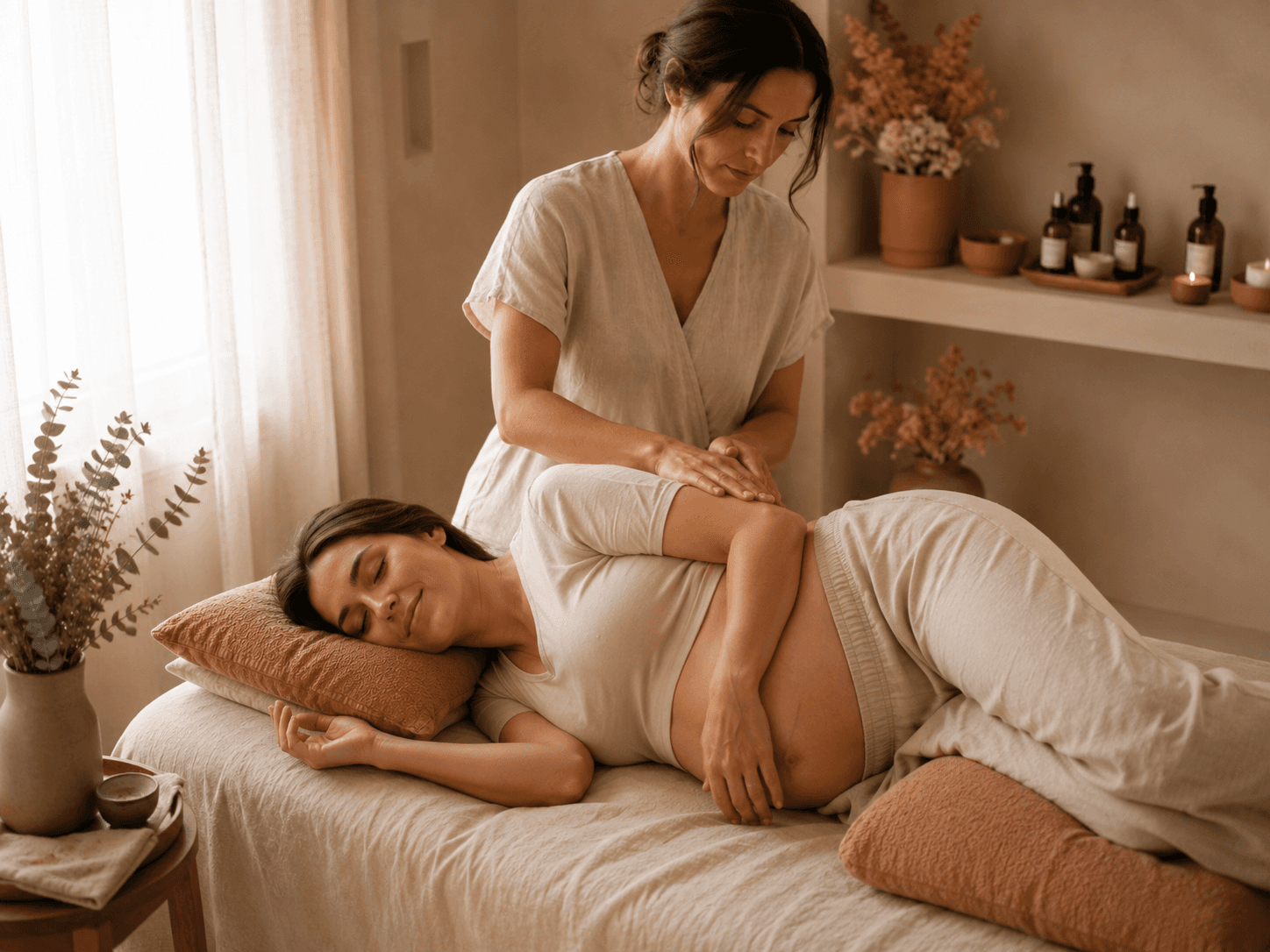
ACOG advises that the best massage position during pregnancy is side-lying rather than face-down, and that guidance shapes how we set up the table from the start. We use pillows and bolsters to support the chest, abdomen, knees, and hips so your body can settle instead of bracing.
- Gentle pressure — soothing and effective, not aggressive.
- Supportive positioning — a side-lying setup reduces pressure through the abdomen and lower back.
- Comfort-first pacing — we adjust for trimester, swelling, sleep trouble, and skin sensitivity.
- Whole-person care — massage, rest, and nervous system regulation work together.
Who Is It For?
We serve expecting mothers dealing with back pain, swelling, stress, hip tightness, leg fatigue, or poor sleep. This work is usually a strong fit for low-risk pregnancy when your body needs relief but deeper or more intense massage would feel like too much. It is especially helpful in the second and third trimesters, when posture changes, pelvic pressure, and sleep disruption tend to build.
Cleveland Clinic notes that the risks are minimal for most healthy pregnancies when the massage is performed by a trained professional and adapted for pregnancy. We ask anyone with a high-risk pregnancy, blood pressure concerns, clotting issues, or other complications to get clearance from their prenatal provider before booking.
- Good candidates — expecting mothers with tension, stress-relief needs, swollen feet, hip pain, or restless sleep.
- Best timing — many clients begin after the first trimester and continue through later pregnancy.
- When to pause and ask your provider — high-risk pregnancy, sudden significant swelling, uncontrolled blood pressure, bleeding, or any symptom your provider is monitoring closely.
- Postpartum care — regular clients often plan follow-up sessions after birth for recovery and rebalancing.
If something has changed since your last visit, even a new area of soreness or a new skin sensitivity, we adjust the session.
What to Expect
When you come in, we focus on making you feel secure before the massage even begins. The first few minutes matter, because a supported body relaxes faster and stays comfortable longer.
We start with positioning. Side-lying support usually includes bolsters under the knees, a pillow between the thighs, and layered support through the chest and upper arm so the shoulders and hips do not pull forward. ACOG and Cleveland Clinic both point to side-lying as the safest default position during pregnancy, especially as your bump grows and lying flat becomes less comfortable.
From there, we use massage that is slow, grounded, and responsive, often focused on the lower back, hips, glutes, shoulders, calves, and feet.
- We use supportive pillows to reduce pressure on the abdomen, hips, and lower back.
- We target the lower back and hips with gentle, steady work to ease tension and improve comfort.
- We adapt products and pressure if you have sensitive or reactive skin.
- We can fold in energy-based support when that fits your goals for relaxation and regulation.
One thing we hear from clients again and again is that more pressure is not always better. During pregnancy, the bigger win is usually smart positioning and consistent, calming contact that lets the muscles stop guarding. We also keep the room quiet and unrushed, which is part of the treatment when sleep has been light or your nervous system feels overstimulated.
Benefits & Results
The main reasons clients book prenatal massage are straightforward: less pain, less swelling, better sleep, and a deeper sense of calm. A 2021 systematic review of randomized trials found that pregnancy massage was associated with lower stress, less back and leg pain, and reduced anxiety and depression symptoms in many study groups. In real life, that means massage can be a useful non-drug support when your body feels overloaded.
- Reduced swelling — gentle, circulation-focused work can help ease fluid buildup in the feet and lower legs, so walking and resting feel more comfortable.
- Better sleep — relaxation work settles muscular tension and bedtime restlessness, and sleep often improves when the body is not fighting hip, shoulder, or low back discomfort.
- Less muscle tension — focusing on common pressure zones can make daily movement, sitting, and getting in and out of bed easier.
- Lower stress — steady therapeutic touch supports downshifting out of a tense, overstimulated state, and that calmer baseline often carries into the rest of the day.
One practical note on swelling: if puffiness is sudden, one-sided, painful, or paired with other symptoms, massage should wait until your prenatal provider weighs in. For ordinary late-day fluid retention, gentle work and smart positioning can be a real relief. In our experience, the best results come from consistency, so weekly or biweekly sessions usually help more than waiting until discomfort spikes.
Why Urban Rituals
Pregnancy massage works best when the practitioner understands more than muscle tension. Candy Iverson founded Urban Rituals and built the practice around whole-person care, with a background that includes massage, esthetics, Reiki, CranioSacral therapy, and yoga-based movement awareness. That matters for clients who care about both bodywork and skin health, because sensitive skin, scent sensitivity, and nervous system overload often show up together.
- Experienced hands — nearly 15 years of practice in massage and healing modalities.
- Holistic approach — bodywork, restorative touch, and skin-aware product choices.
- Comfort-driven sessions — we adapt each visit to your stage of pregnancy and daily symptoms.
- Gentle products — we favor lower-fragrance options when products are used on sensitive skin.
You are not dropped into a generic spa routine. We listen, adjust, and work with what your body is actually asking for that day.
Pricing & Booking
Our prenatal massage is $150 for a 75-minute session, and that longer length gives us enough time to set up support properly and still do meaningful bodywork. Book online through the Vagaro scheduler, or call the studio if you would like help choosing.
- Prenatal Massage — $150 · 75 min (available after the first trimester)
- Continuing after birth? Ask about postpartum massage for recovery and rebalancing.
Urban Rituals · 3333 Midway Drive #104, San Diego, CA 92110 · (619) 786-6159
Medical clearance is required first for high-risk pregnancies or pregnancy complications. Booking a small series ahead of your tougher weeks, especially in the later second and third trimesters, makes it easier to keep your schedule steady.